

What we saw at UNGA 2026

 A health programme can count vaccine doses delivered and still not know which children received them. That gap is what Simprints works on, and it shaped what we noticed at UNGA this year. Toby Norman, Simprints’ CEO and Co-founder, and Jenny Thornton, our Head of Global Partnerships spent four days in New York at UN events, roundtables and partner meetings. Three themes dominated UNGA.
AI is a tool for specific jobs
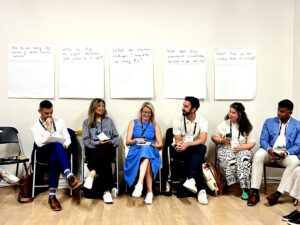
Jenny co-led The Sidebar’s session “The AI Health Opportunity: Building Care Where Resources Are Scarce”. Her co-leaders were Noelle Huskins Madden (Camber Collective), Malcolm Quigley (Population Services International), Rich Bryson (Spirit Health Foundation), Isabel Mares (American India Foundation) and Nabil Ahmed (Integral Global).
The lesson she shared comes from Simprints’ own experience. AI is powerful when a specific bottleneck needs complex pattern recognition at scale. There is no fix when the infrastructure underneath is broken.
Children are still being missed
At a Nutrition International event, Joel Spicer spoke urgently about children falling through the cracks. He called for nutrition and immunisation to be delivered together, so that a child is fully protected, even if that means breaking legacy structures. The same problem showed up in supply. Ready-to-use therapeutic food (RUTF) treats severe malnutrition, but some RUTF gets diverted before it reaches a child. When nobody can track it, accountability fails and children are missed. And the health of children suffers.
The most encouraging moment of the week for us came at UNICEF House. Act For Early Years announced the countdown to the first Global Early Years Finance Summit, which comes to London in 2027 during the UK’s presidency of the G20, and Gordon Brown, the UN Special Envoy for Global Education, called on the room to act. The event set out where money for early childhood does the most good, and one recommendation led the list: nutritional support from birth, paired with growth monitoring. That is the work Simprints is building towards, with malnutrition detection and patient identification from the day of birth both in development.
Funding is being rethought
At an ELMA Philanthropies session on funders scaling with government, Alex Storey of Spring Impact made a point about risk. Governments assess nonprofit technology organisations like Simprints through the lens of risk, regardless of the innovation’s promise. That gives funders a particular role. They can absorb the early-stage risk that governments cannot, and use their influence strategically.
We ended a day of back-to-back meetings with a final evening hosted by Cisco, our trusted social impact partner, who backs the work that technology for social good needs to scale.
Who are we reaching, and at what cost?
On the Wednesday of UNGA week, Simprints hosted a workshop with The Sidebar: “We need to know who we’re reaching, but at what cost?”
Osei Kwadwo Boateng, Founder and Executive Director of the OKB Hope Foundation, shared the foundation’s journey to digital records and a near miss along the way. Two patients had very similar names and completely different diagnoses. Each was prescribed the other’s medication. A pharmacist noticed the mismatch and called the doctor to check. Osei’s conclusion: a unique identifier would remove that risk. Biometrics can prevent that kind of mix-up. They also add costs and risk.
We build biometric identification, so these are questions about our own work. We would rather they were asked. In health care, we see the job of biometrics as continuity of care: confirming that the person in front of a health worker is the same person who came before. That is a narrower task than establishing who someone is, and it works alongside the records a programme already keeps.
The risks deserve the same plain treatment. A central store of identity data is a target, so how biometric data is protected matters as much as how it is captured.
Thank you to Osei and to everyone who joined us and who made time for us in New York: The Sidebar, Devex, the Alliance for Innovation in Global Health, The END Fund, the Elevate Prize Foundation, Cisco, ELMA Philanthropies, Action Against Hunger, CHIC, Edesia, Panorama Strategy, Grand Challenges Canada, UN for Digital and Emerging Technologies, Gavi The Vaccine Alliance, Nutrition International, 100x
If you are working on any of these questions, write to us at [email protected].